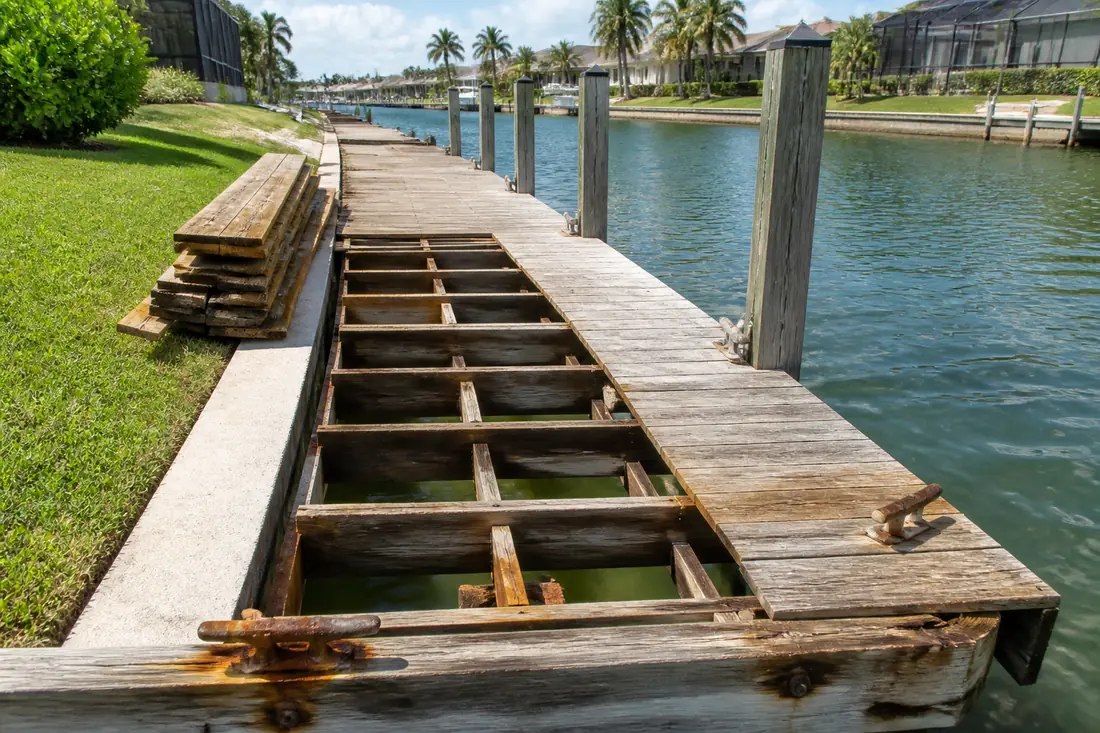
Boat Dock Repair in Cape Coral, FL — What to Expect
Docks fail from the fixings outward as often as from the timber inward. Saltwater is hard on fasteners and connectors, and a frame that looks sound can be held together by hardware that is most of the way through its life. What a dock needs is usually decided by what is holding it together rather than by what is walked on.
Repairs run from replacing decking boards and corroded fixings through to piling repair and reframing sections. Where a dock is fixed to a seawall, the condition of the wall is checked at the same time, because movement in the wall shows up in the dock.
What Is Included
- Fixings and connectors assessed, not just the decking
- Piling condition checked at and below the waterline
- Frame movement traced back to its cause, including the seawall
- Decking replaced in matching material where the frame is sound
- Corrosion-resistant hardware specified for saltwater exposure
The Boat Dock Repair Process
- 1
Step 1: Check the Fixings First
Corroded fasteners and connectors are the most common reason a dock feels loose, and they are cheap to address early. Decking replaced over failing hardware looks new and moves the same.
- 2
Step 2: Assess the Pilings
Pilings deteriorate at the waterline and below it, where the damage is hardest to see. What is happening under the surface decides whether a dock is a repair or a rebuild.
- 3
Step 3: Trace Movement to Its Cause
A dock that has shifted may have failed on its own, or may be following a seawall that is moving. Repairing the dock without checking the wall means repairing it again after the wall is dealt with.
- 4
Step 4: Repair, Replace and Refasten
Sound material kept, failed material replaced, and everything refastened with hardware specified for saltwater so that the repair is not the next thing to corrode.
Types of Boat Dock Repair in Cape Coral
Decking Replacement
Replacing weathered, cupped or splintering boards where the frame beneath is sound, in a material chosen for how hot it gets underfoot in summer as well as for durability.
Piling Repair and Wrapping
Restoring pilings that have deteriorated at or below the waterline, including protective wrapping where the remaining section is sound enough to keep.
Frame and Stringer Repair
Replacing framing that has failed or worked loose, and correcting fall where water has begun to stand on the deck rather than run off it.
Storm Damage Repair
Rebuilding sections lost or displaced by surge and debris, assessed together with the seawall behind since the two commonly take damage in the same event.
What Matters When Choosing a Docks and Lifts Contractor in Cape Coral, FL
The cause gets found before the wall gets patched
Cracking and settlement behind a seawall are usually symptoms of soil moving through it, not of the concrete itself failing. Where the water is getting through decides what the repair actually is.
Repair and replacement priced as separate answers
A wall with sound panels and a failed cap is a different job from a wall that has lost its footing. Both get assessed, and which one this is gets said plainly rather than defaulting to the larger scope.
Built for saltwater and tide loading
Canal walls sit in brackish water with a tide cycle behind them. Materials and fixings are specified for that exposure, because galvanized steel corrodes faster in salt spray and tidal conditions than in fresh water.
Permitting handled as part of the work
Inside Cape Coral city limits the City issues the marine improvement permit for seawall work. On saltwater canals that is not the whole picture — state approval through FDEP or a US Army Corps authorization under SAJ-91 can apply as well, which the City guideline requires except on fresh water. Which approvals apply is established before a scope is priced rather than discovered mid-job.
Boat Dock Repair FAQs
My dock feels bouncy. Is that structural?
Often it is the fixings rather than the timber. Saltwater corrodes fasteners and connectors faster than it degrades the framing, and a frame held by hardware that has lost section moves under load while still looking sound. It can also indicate a failed stringer or a piling that has deteriorated below the waterline, so it is worth having identified rather than assumed either way.
Can dock pilings be repaired instead of replaced?
Sometimes. Where deterioration is confined to the splash zone and the piling retains enough sound section below it, repair and protective wrapping can extend its life considerably. Where the loss is at or below the mudline, or where the remaining section will not carry the load, replacement is the honest answer. What determines it is what is found below the waterline rather than what is visible above.
Other Services in Cape Coral
- Boat Dock ConstructionNew docks on canal and river frontage, sized around the vessel and the water depth rather than the lot width.
- Boat Lift InstallationLifts sized to the vessel and to what the seawall and pilings can actually carry.
- Shoreline Erosion ControlStabilizing a shoreline that is losing ground, using the approach the site and the permitting actually allow.