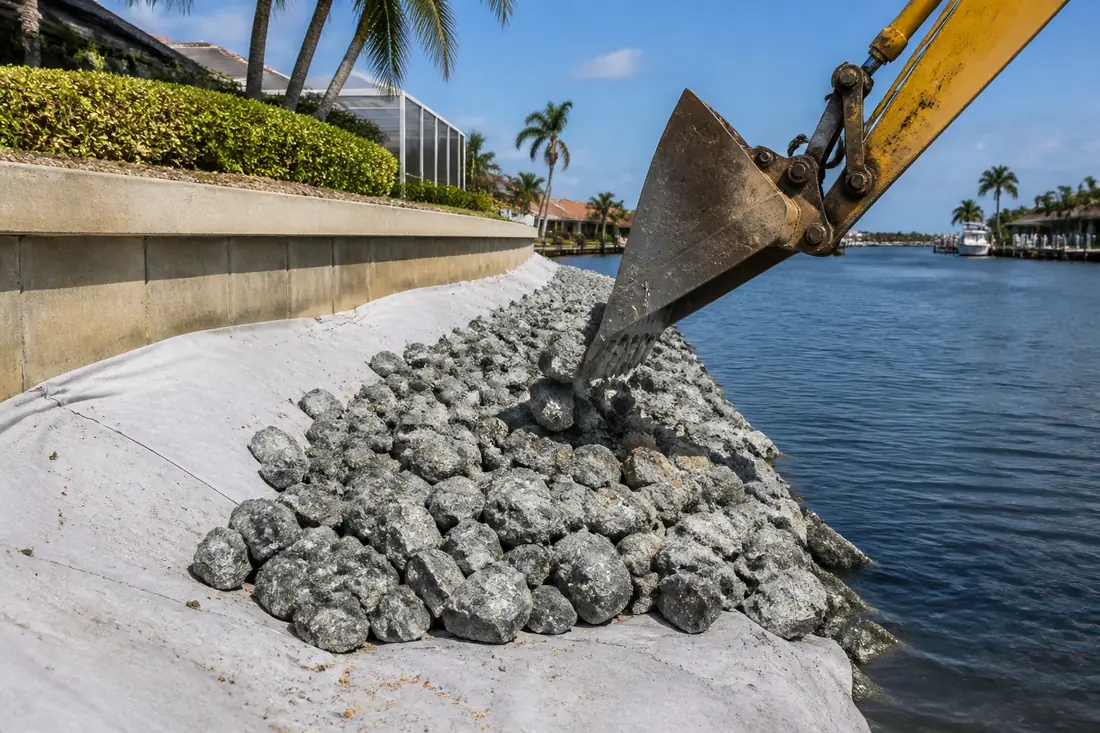
Riprap and Rock Revetment in Cape Coral, FL — What to Expect
Riprap is graded rock placed against a shoreline or at the base of a seawall. It breaks up wave energy before it reaches the structure and protects the toe of a wall from the scour that undermines it. On a wall that is sound but exposed, it is often the difference between a long service life and a short one.
It is also used as an alternative to a vertical wall on shorelines where a sloped, permeable edge suits the site and the permitting better than a hard wall does. Whether that is an option depends on the waterway, on how much shoreline can be given up to the slope, and on what the approvals allow.
What Is Included
- Rock sized for the exposure rather than for what is cheapest to deliver
- Filter layer beneath so the rock does not simply sink into soft ground
- Toe protection for existing walls at risk of undermining
- Slope and coverage set for the water conditions on that stretch
- Permitting requirements established before material is ordered
The Riprap and Rock Revetment Process
- 1
Step 1: Establish the Exposure
Wave and wake energy on a canal is different from an open bay frontage, and the rock has to be sized for it. Undersized rock migrates and ends up needing replacing rather than topping up.
- 2
Step 2: Confirm What the Permitting Allows
Riprap changes the shoreline edge and how far a structure extends into the waterway, so approvals are established at the start. That answer can change the slope and the footprint.
- 3
Step 3: Prepare the Bed and Filter Layer
Rock placed straight onto soft ground works its way in and stops protecting anything. A graded filter layer underneath keeps the rock where it was placed and lets water pass without carrying soil.
- 4
Step 4: Place and Key the Rock
Placed to the designed slope and keyed together rather than tipped, with the toe set low enough that scour undermines the rock rather than the structure behind it.
Types of Riprap and Rock Revetment in Cape Coral
Seawall Toe Protection
Rock placed at the base of an existing wall to stop scour undermining the footing, which is commonly what turns a repairable wall into a replacement.
Shoreline Revetment
A sloped rock edge used in place of a vertical wall where the site and the approvals suit it, giving a permeable edge that absorbs energy rather than reflecting it.
Scour Repair and Rock Replacement
Restoring existing riprap that has migrated, settled or been displaced by storm energy, including re-establishing the filter layer where it has been exposed.
Vegetated and Hybrid Edges
Combining rock with planting where a softer edge is wanted or required, which can suit both the appearance and, on some waterways, the permitting.
What Matters When Choosing a Shoreline Contractor in Cape Coral, FL
The cause gets found before the wall gets patched
Cracking and settlement behind a seawall are usually symptoms of soil moving through it, not of the concrete itself failing. Where the water is getting through decides what the repair actually is.
Repair and replacement priced as separate answers
A wall with sound panels and a failed cap is a different job from a wall that has lost its footing. Both get assessed, and which one this is gets said plainly rather than defaulting to the larger scope.
Built for saltwater and tide loading
Canal walls sit in brackish water with a tide cycle behind them. Materials and fixings are specified for that exposure, because galvanized steel corrodes faster in salt spray and tidal conditions than in fresh water.
Permitting handled as part of the work
Inside Cape Coral city limits the City issues the marine improvement permit for seawall work. On saltwater canals that is not the whole picture — state approval through FDEP or a US Army Corps authorization under SAJ-91 can apply as well, which the City guideline requires except on fresh water. Which approvals apply is established before a scope is priced rather than discovered mid-job.
Riprap and Rock Revetment FAQs
Will riprap stop my seawall from failing?
It addresses one specific failure mode: scour at the base of the wall that undermines the footing. Where that is what is happening, rock at the toe can meaningfully extend a wall’s life. Where the problem is failed anchors, a cracked cap or fill escaping through the joints, riprap does not touch it. Which of those applies is what an assessment is for.
Is riprap cheaper than a seawall?
It is usually less expensive per foot than a vertical wall, though it takes up more shoreline because it slopes rather than standing upright, and the approvals differ. Whether it is a viable alternative on a given property depends on the waterway, on how much edge can be given to the slope, and on what permitting allows there. Both routes get priced where both are genuinely available.
Other Services in Cape Coral
- Seawall Cap RepairCracked, spalling or separating concrete caps cut back to sound material and rebuilt.
- Seawall Panel ReplacementCracked, bowing or separated wall panels replaced individually where the rest of the structure is sound.
- Seawall RepairCracked caps, bowing panels, open joints and soil washing out from behind the wall — assessed for cause, then repaired.