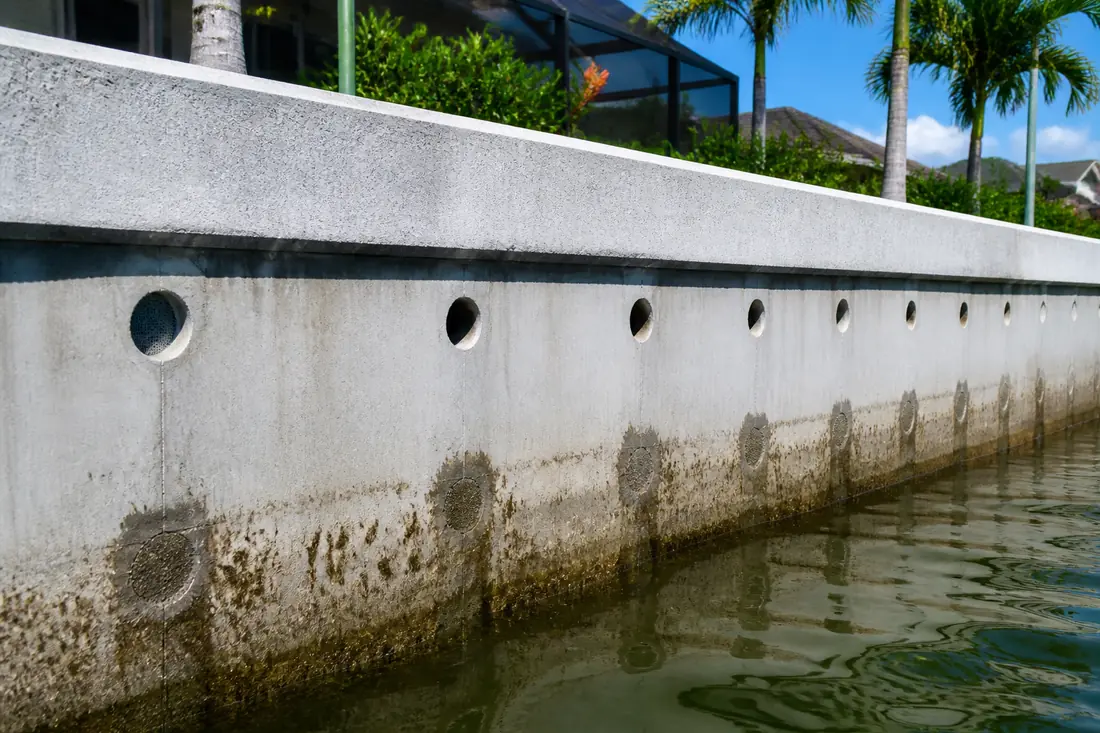
Seawall Drainage and Weep Holes in Cape Coral, FL — What to Expect
Water behind a seawall is the load the wall was designed around. Weep holes and filter material let it drain out so that pressure does not build, and when they block, the wall carries considerably more than it was built for. A great many problems that present as structural start as drainage.
Restoring drainage is among the least expensive work available on a seawall and among the most useful, because it addresses a cause rather than a symptom. It is normally done alongside other repair, since the filter material behind blocked weep holes is often the same material that has been washing out through the joints.
What Is Included
- Existing weep holes located and tested rather than assumed clear
- Blockages cleared and filter material restored behind them
- New weep holes added where a wall has too few for its length
- Filter fabric detailed so it drains water without passing soil
- Surface drainage behind the wall reviewed at the same time
The Seawall Drainage and Weep Holes Process
- 1
Step 1: Find and Test the Existing Drainage
Weep holes are easy to miss and easy to assume are working. Locating them along the run and checking whether they actually pass water establishes what is there before anything is added.
- 2
Step 2: Establish Why They Blocked
Weep holes block because filter material has failed, because they were never filtered, or because the ground behind has silted them. Which of those it is decides whether clearing them will hold.
- 3
Step 3: Clear, Filter and Add Where Needed
Existing holes cleared and re-filtered, and additional ones cut where a wall has too few for its length, so that drainage is distributed rather than concentrated at two or three points.
- 4
Step 4: Review What Sends Water There
Downspouts, pool deck drainage and irrigation all put water into the ground behind a wall. Where those are aggravating the load, saying so costs nothing and often changes the outcome.
Types of Seawall Drainage and Weep Holes in Cape Coral
Weep Hole Clearing
Restoring flow through existing holes that have silted or blocked, which is the least expensive intervention available on most walls showing pressure-related symptoms.
Filter Restoration
Replacing the stone and fabric behind weep holes so they pass water without passing soil. Unfiltered weep holes drain a wall and empty the ground behind it at the same time.
Additional Weep Holes
Cutting further drainage points into a wall that has too few for its length, distributing the flow rather than concentrating it where it will scour.
Surface Drainage Review
Looking at what puts water into the ground behind the wall in the first place, including roof drainage and irrigation, since reducing that reduces the load the wall carries.
What Matters When Choosing a Seawalls Contractor in Cape Coral, FL
The cause gets found before the wall gets patched
Cracking and settlement behind a seawall are usually symptoms of soil moving through it, not of the concrete itself failing. Where the water is getting through decides what the repair actually is.
Repair and replacement priced as separate answers
A wall with sound panels and a failed cap is a different job from a wall that has lost its footing. Both get assessed, and which one this is gets said plainly rather than defaulting to the larger scope.
Built for saltwater and tide loading
Canal walls sit in brackish water with a tide cycle behind them. Materials and fixings are specified for that exposure, because galvanized steel corrodes faster in salt spray and tidal conditions than in fresh water.
Permitting handled as part of the work
Inside Cape Coral city limits the City issues the marine improvement permit for seawall work. On saltwater canals that is not the whole picture — state approval through FDEP or a US Army Corps authorization under SAJ-91 can apply as well, which the City guideline requires except on fresh water. Which approvals apply is established before a scope is priced rather than discovered mid-job.
Seawall Drainage and Weep Holes FAQs
What are the holes along the bottom of my seawall for?
They are weep holes, and they let water drain out from behind the wall. Saturated ground pushes considerably harder against a wall than drained ground does, so those holes are part of how the wall carries its load. When they block, the wall takes more pressure than it was designed for, which is why drainage problems frequently present as structural ones.
Is it bad that soil is coming out of my weep holes?
It generally means the filter behind them has failed. A weep hole is supposed to pass water and hold soil back, and when the stone and fabric behind it break down it does both. Soil arriving on the canal side is the same soil leaving the ground behind your wall, so it is worth addressing before the surface above starts to settle.
Other Services in Cape Coral
- Riprap and Rock RevetmentRock placed at the toe of a wall or along a shoreline to absorb wave energy and stop undermining.
- Piling Repair and ReplacementRepair, wrapping and replacement of dock, lift and mooring pilings that have deteriorated at the waterline.
- Shoreline Erosion ControlStabilizing a shoreline that is losing ground, using the approach the site and the permitting actually allow.