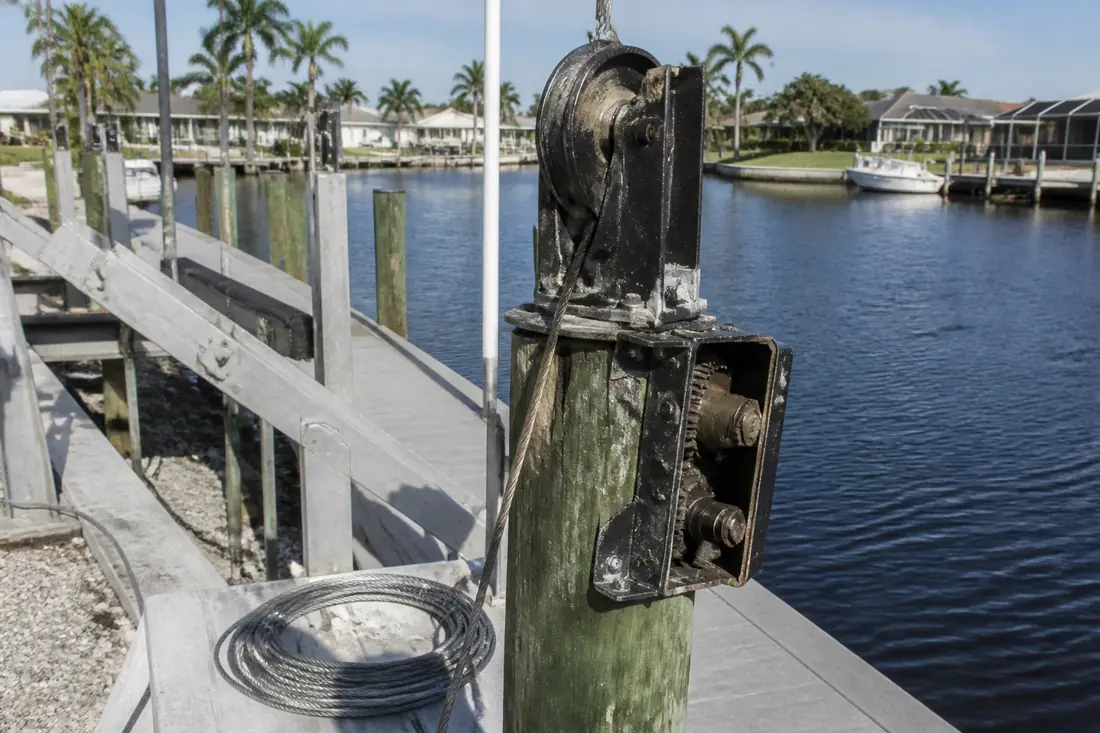
Boat Lift Repair in Cape Coral, FL — What to Expect
Lift problems are usually mechanical or electrical rather than structural, and most of them announce themselves before they fail. Cables that have begun to fray, a lift that lands unevenly, a motor that hesitates or runs hot — those are the point at which a repair is small.
The exception is when the pilings or the seawall behind them have moved, which puts a lift out of alignment no matter what is done to the mechanism. Where a lift will not run true after adjustment, what it is mounted to is worth checking before more parts are replaced.
What Is Included
- Cables inspected along their length, including at the drums
- Motors, gearboxes and controls tested under load
- Alignment checked against the pilings and the wall behind
- Bunks and cradles reset so the hull is supported properly
- Saltwater-rated replacement components rather than general hardware
The Boat Lift Repair Process
- 1
Step 1: Run It and Watch It
Most faults show under load. How a lift lifts, where it hesitates, whether it lands level and what it sounds like at each stage narrow the cause considerably before anything is dismantled.
- 2
Step 2: Inspect the Cables End to End
Cables fail at the drums and at the sheaves more often than mid-span, which are the places least likely to be looked at. Fraying found there is a repair; found later it is usually more than that.
- 3
Step 3: Check Alignment Against the Structure
A lift that will not run true after adjustment may be following pilings or a seawall that has moved. Continuing to replace mechanical parts against a structural cause gets expensive quickly.
- 4
Step 4: Repair, Replace and Re-test Under Load
Components replaced with saltwater-rated equivalents, bunks reset to support the hull correctly, and the lift run through its full travel under load before it is handed back.
Types of Boat Lift Repair in Cape Coral
Cable and Sheave Replacement
Replacing cables that have frayed or corroded, along with the sheaves they run over, since a worn sheave takes the life out of a new cable quickly.
Motor and Gearbox Repair
Diagnosing and repairing drive units that hesitate, run hot or have stopped, including the switchgear and wiring that is frequently the actual fault.
Bunk and Cradle Adjustment
Resetting the supports so the hull is carried where it should be. A hull sitting on poorly set bunks takes load in places it was not designed to.
Piling and Mounting Repair
Addressing the structure a lift is fixed to, where movement in the pilings or the seawall is what has put the installation out of true.
What Matters When Choosing a Docks and Lifts Contractor in Cape Coral, FL
The cause gets found before the wall gets patched
Cracking and settlement behind a seawall are usually symptoms of soil moving through it, not of the concrete itself failing. Where the water is getting through decides what the repair actually is.
Repair and replacement priced as separate answers
A wall with sound panels and a failed cap is a different job from a wall that has lost its footing. Both get assessed, and which one this is gets said plainly rather than defaulting to the larger scope.
Built for saltwater and tide loading
Canal walls sit in brackish water with a tide cycle behind them. Materials and fixings are specified for that exposure, because galvanized steel corrodes faster in salt spray and tidal conditions than in fresh water.
Permitting handled as part of the work
Inside Cape Coral city limits the City issues the marine improvement permit for seawall work. On saltwater canals that is not the whole picture — state approval through FDEP or a US Army Corps authorization under SAJ-91 can apply as well, which the City guideline requires except on fresh water. Which approvals apply is established before a scope is priced rather than discovered mid-job.
Boat Lift Repair FAQs
How often should boat lift cables be replaced?
Intervals vary a great deal with use, exposure and how the lift is maintained, so a fixed figure would be misleading. Condition is the better guide: fraying at the drums or sheaves, visible corrosion, or flattened sections all indicate a cable near the end of its life. Those points are worth inspecting regularly, because they are where cables fail and they are the least visible parts of the run.
My lift is not lifting level. What causes that?
Commonly uneven cable tension or wear on one side, and it is usually correctable by adjustment. Where adjustment does not hold it, the cause is often that the pilings or the seawall the lift is mounted to have moved, which puts the whole frame out of true. That is worth checking before further mechanical parts are replaced against what is actually a structural cause.
Other Services in Cape Coral
- Shoreline Erosion ControlStabilizing a shoreline that is losing ground, using the approach the site and the permitting actually allow.
- New Seawall ConstructionNew wall construction on a lot without one, or where a shoreline is being converted to a hard edge.
- Boat Dock ConstructionNew docks on canal and river frontage, sized around the vessel and the water depth rather than the lot width.