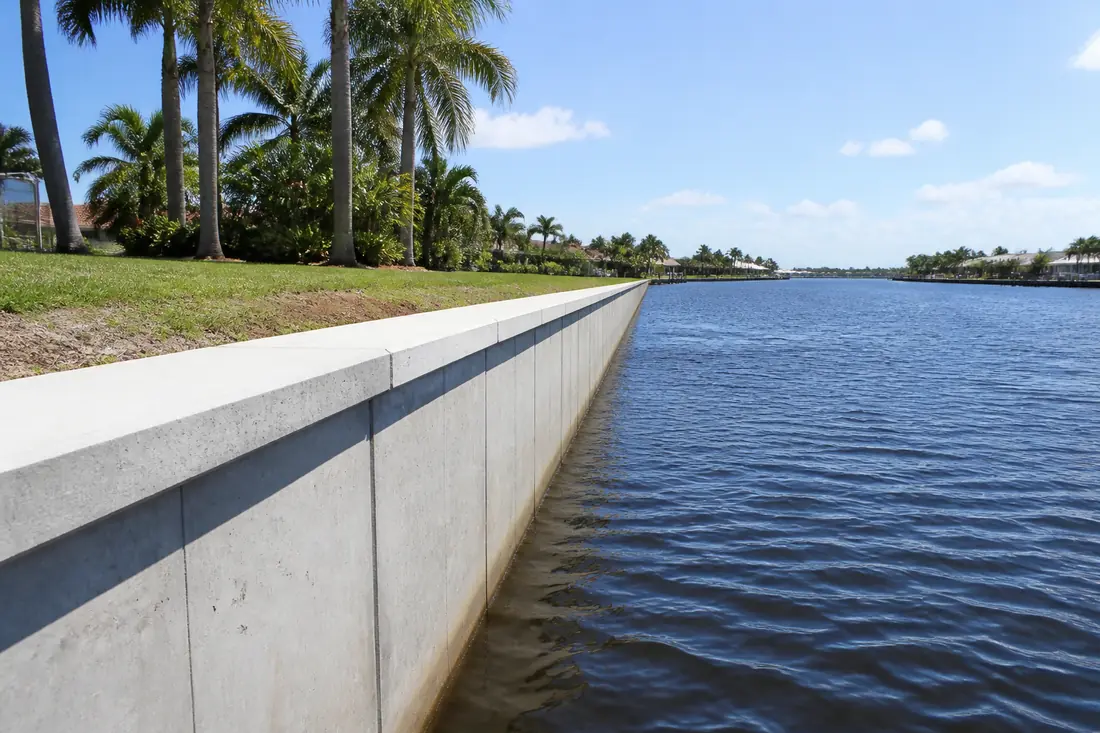
Most seawall conversations in Cape Coral are about the state. Whether the work qualifies as a repair or a replacement, whether it falls inside a Florida exemption, what the environmental resource permitting rules say about how far waterward you may go. Those are the right questions and they take up most of the oxygen.
They also do not answer a separate question that runs alongside them the whole time: whether the Army Corps of Engineers has to authorize the work.
The two systems are genuinely independent. A project can be exempt under Florida’s rules and still need federal authorization, because the federal authority comes from a different statute, protects a different interest, and does not consult the state exemption in deciding whether it applies. Owners find this out at various points in a project, and the later it happens the more it costs.
Federal authorization is often less of an obstacle than people fear. The nationwide permits exist precisely to cover categories of work the Corps has already judged to have minimal individual and cumulative effects, and where a project fits one, the process is far lighter than an individual permit. But general permits have structure, they have expiry dates, and they have rules about how they may be combined that catch people who assume a permit is a permit.
Last reviewed: 10 September 2026 against 33 CFR Parts 322 and 330 as published by the Government Publishing Office, 2024 annual edition. This guide covers the federal track; the Florida exemptions are a separate subject, covered in our guide to when a seawall repair needs a permit.
Why a seawall is a federal matter at all
The authority is old. Section 10 of the Rivers and Harbors Act gave Congress’s power over navigation to the executive, and 33 CFR 322 records the arrangement plainly at § 322.3(c)(2): “Congress has delegated to the Secretary of the Army in section 10 the duty to authorize or prohibit certain work or structures in navigable waters of the United States, upon recommendation of the Chief of Engineers.”
The part then defines what counts as a structure, and the list settles any doubt about whether shoreline work is included. A structure “shall include, without limitation, any pier, boat dock, boat ramp, wharf, dolphin, weir, boom, breakwater, bulkhead, revetment, riprap, jetty, artificial island, artificial reef, permanent mooring structure, power transmission line, permanently moored floating vessel, piling, aid to navigation, or any other obstacle or obstruction.”
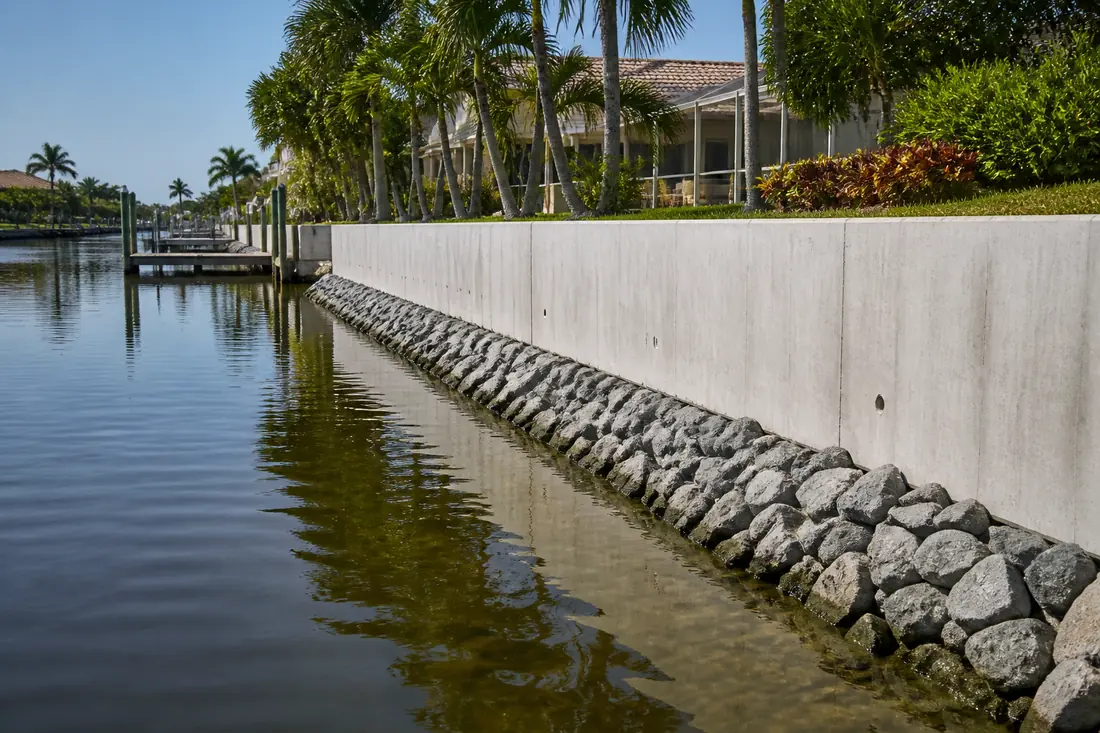
Bulkhead is the engineering word for a seawall. Revetment and riprap are there too. A vertical wall, a sloped rock face and the stone at the toe of an existing wall are all named structures.
“Work” is defined separately and just as broadly — “any dredging or disposal of dredged material, excavation, filling, or other modification of a navigable water of the United States.” Backfilling behind a new wall is modification.
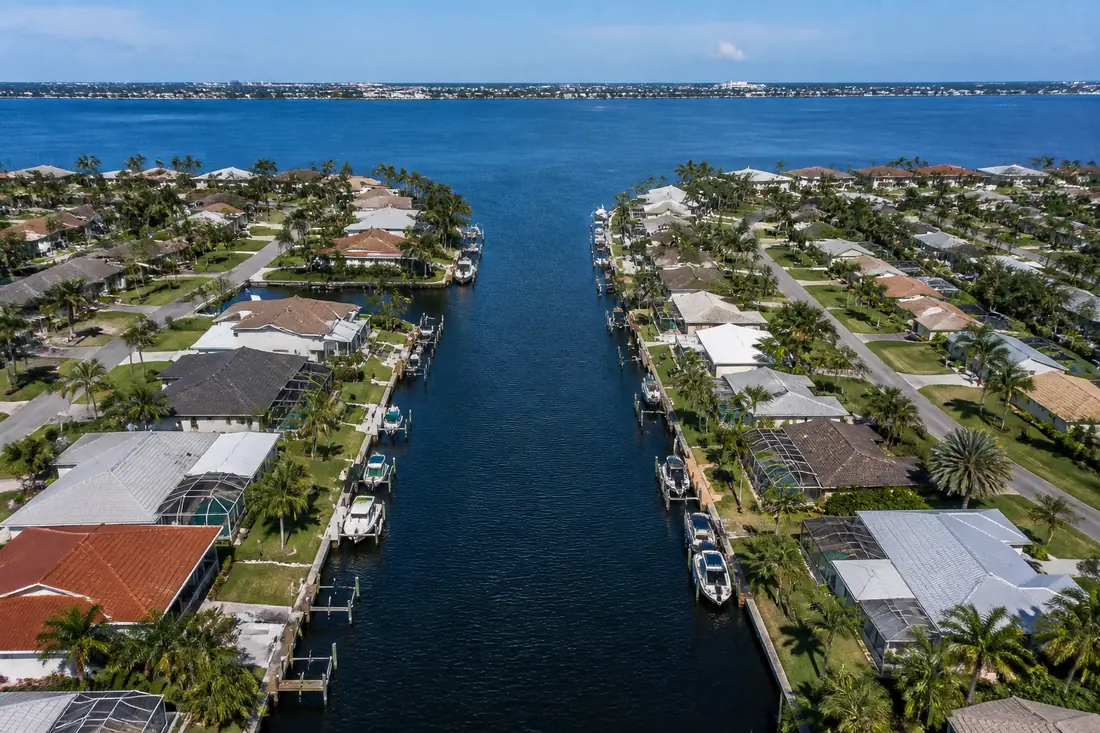
The question that decides whether any of this reaches your property is therefore not what you are building. It is whether the water in front of it is a navigable water of the United States. In a system like Cape Coral’s — canals connecting to larger waterways and out to the Gulf — that is a question with a real answer, and it is one to establish early rather than assume.
What a nationwide permit actually is
Individual permits are the heavyweight process: a project-specific application, a public interest review, public notice. Almost no residential seawall goes that route, and that is by design.
A nationwide permit is a type of general permit which, in the words of 33 CFR 330.2, “authorizes activities on a nationwide basis unless specifically limited.” The Corps decides in advance that a defined category of minor work, within stated limits and subject to stated conditions, has effects slight enough to be authorized without reviewing each case.
The practical consequence is that the analysis inverts. With an individual permit you make a case for your project. With a nationwide permit you demonstrate that your project fits inside a description someone else wrote. Everything then turns on the terms and conditions of the particular NWP, and on whether your work stays within them.
Part 330 is the framework — how NWPs are issued, modified, suspended and revoked, and how an activity becomes authorized under one. The terms of each individual nationwide permit are published separately by the Corps rather than set out in this part, and they are reissued periodically. That distinction matters when you are checking limits: Part 330 tells you how the system works, and the current NWP text tells you what you are allowed to build.
The five-year clock, and the twelve-month tail
Nationwide permits are not permanent instruments, and this surprises people who think of a permit as something you obtain and hold.
Section 330.6(b) is explicit: “If an NWP is not modified or reissued within five years of its effective date, it automatically expires and becomes null and void.”
There is protection for work already under way. Activities “which have commenced (i.e, are under construction) or are under contract to commence in reliance upon an NWP will remain authorized provided the activity is completed within twelve months of the date of an NWP’s expiration, modification, or revocation” — unless discretionary authority has been exercised to modify, suspend or revoke the authorization in that particular case.
And work already finished stays finished: “Activities completed under the authorization of an NWP which was in effect at the time the activity was completed continue to be authorized by that NWP.”
Two things follow for an owner. A verification obtained some time ago is not necessarily still good — Section 330.6(a) provides that a district engineer’s verification states that it is valid for a specific period of time, generally until the expiration date of the NWP. And a project that stalls has a clock on it. A seawall permitted, started, and then paused for a season while money or weather is sorted out can run into the twelve-month tail without anyone noticing that a tail exists.
The rule that stops the obvious workaround
Section 330.6(c) contains a provision that is easy to miss and expensive to misjudge:
Two or more different NWPs can be combined to authorize a “single and complete project”. However, the same NWP cannot be used more than once for a single and complete project.
Read the second sentence as the answer to a question somebody was clearly asking. If a nationwide permit has a numerical limit, you cannot get twice the limit by describing your work as two projects and claiming the same NWP twice.
“Single and complete project” is a defined term, and § 330.2(i) puts it in terms of ownership and the whole of the work rather than of contracts or phases: “the total project proposed or accomplished by one owner/developer or partnership or other association of owners/developers.” The example the regulation gives is a residential development touching several separate waters, where “the cumulative total of all filled areas should be the basis” for the decision.
Splitting one seawall into two invoices, or running it as two seasons of work, does not make it two projects.
The first sentence is the constructive half. Where a job genuinely involves different kinds of work — a wall, and a dock, and a rock toe — different NWPs may each cover their part of it, combined into one authorization for the whole.
Where the state comes back in
The two systems are independent, but they touch at two specific points, and both are relevant in Florida.
Section 330.4(c) requires state water quality certification under section 401 of the Clean Water Act, or a waiver, “prior to the issuance or reissuance of NWPs authorizing activities which may result in a discharge into waters of the United States.” Section 330.4(d) does the equivalent for coastal zone management consistency. Where a state has denied certification or not concurred, the district engineer’s response will state that the activity meets the NWP’s terms with that exception and “cannot be authorized until the requirements” are satisfied.
The Corps does not simply substitute its own judgment where a state says no. But Section 330.4(c)(5) is careful about the reverse too: the district engineer will not require an individual permit application “solely on the basis that the 401 water quality certification has been denied for that NWP”, though water quality may be considered among other factors in deciding whether to exercise discretionary authority.
Discretionary authority is worth knowing as a concept. It is the power delegated to division and district engineers “to modify an NWP authorization by adding conditions, to suspend an NWP authorization, or to revoke an NWP authorization and thus require individual permit authorization.” A nationwide permit is a standing decision, not a guarantee, and a district engineer may take a particular project out of it.
What a professional establishes, and in what order
The sequence matters because each answer narrows the next question.
- Is the waterbody a navigable water of the United States? This determines whether Section 10 reaches the property at all.
- What is the work, in the code’s terms? A structure, work, or both. Repair of an existing wall in place, replacement on the same alignment, a new wall waterward of the old one and backfilling behind it are materially different descriptions.
- Does it fit a current nationwide permit’s terms? Against the NWP text in force now, not a copy from a previous cycle.
- Does the NWP require preconstruction notification? Some do. Where notification is required, work does not begin on the owner’s own assessment.
- Are the state certifications in place for that NWP in Florida?
- What are the dates? Expiry of the NWP, and validity of any verification.
What drives the cost and the timeline
There is no meaningful single figure for permitting without knowing the waterbody, the scope and whether notification is triggered. What moves it:
- Whether notification is required. A project proceeding under an NWP with no notification is on a very different schedule from one awaiting a district engineer’s response.
- Scope creep from repair toward replacement. The description drives which authorizations apply, and scope decided on site is scope decided after the paperwork.
- Alignment. Anything that moves the structure waterward changes the analysis under both systems at once.
- Survey and drawings. Federal review works from an accurate description of what is being built and where.
- Season. Applications queue, and Southwest Florida’s construction season is not evenly loaded.
Three mistakes worth avoiding
Treating a state exemption as the end of the matter. They are different statutes protecting different interests. Exempt under one is silent about the other.
Relying on an old verification or an old NWP number. Five-year reissuance means the text changes, and a verification carries its own validity period.
Splitting a project to fit under a limit. Section 330.6(c) addresses this directly, and “single and complete project” is defined so that phasing does not create separate projects.
Before you sign
Ask your contractor which authorizations the work will proceed under — state and federal, named separately. Ask whether preconstruction notification is required and who is responsible for it. Ask whether any verification already held is still within its validity period.
A contractor who answers those in specifics has done this before on your canal system. One who answers that seawalls do not need federal permits is describing a conclusion rather than a check.
The sequence that saves money is to settle the description of the work — repair, replacement, alignment — before anything is ordered, because that description is what both permitting systems are reading.
This guide explains federal permitting requirements in plain language and is not legal advice. The Corps’ current regulations, the terms of the nationwide permits in force, and the district engineer’s determination for a specific property control what is actually required.
Sources
- 33 CFR Part 330 — Nationwide Permit Program, 2024 annual edition, U.S. Government Publishing Office. Purpose and policy at § 330.1; definitions including nationwide permit, discretionary authority and single and complete project at § 330.2; conditions and state 401 water quality certification at § 330.4; authorization, expiration and combination of NWPs at § 330.6.
- 33 CFR Part 322 — Permits for Structures or Work In or Affecting Navigable Waters of the United States, 2024 annual edition. The Section 10 authority — review of permits for structures or work in or affecting navigable waters “pursuant to section 10 of the Rivers and Harbors Act of 1899 (33 U.S.C. 403)” — at § 322.1; the definition of structure, which names bulkhead, revetment and riprap among others, at § 322.2(b), and of work at § 322.2(c).