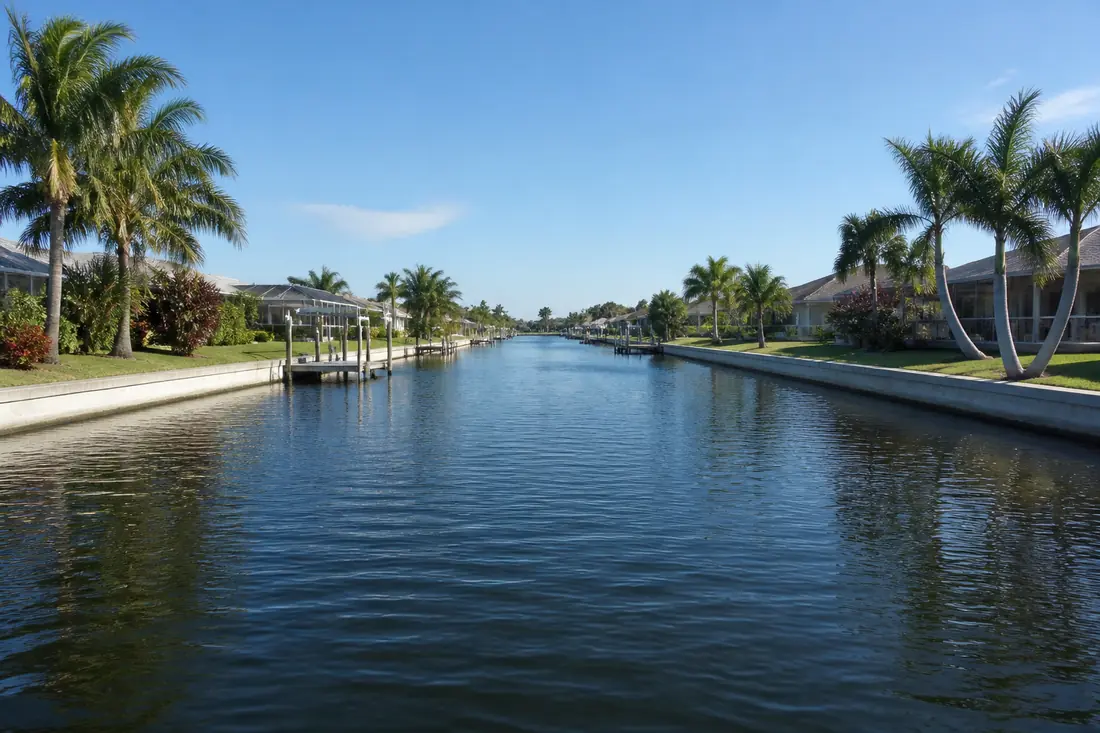
The first sign is almost never the wall.
It is a sprinkler head sitting an inch lower than the grass around it. A paver near the water that rocks underfoot. A thin gap under the edge of the pool deck that was not there last spring. Small things, easy to file under settling.
The wall itself looks fine. The cap runs straight, the panels are in line, nothing leans.
That combination — a moving yard and a still wall — is the most common early presentation of seawall failure here, and it catches people out because it is the reverse of what they expect. Concrete seawalls on a canal tend to fail quietly, from behind, and by the time the structure moves the process has usually been running for years.
Understanding why means looking at what sits on the other side of the wall.
The canal is infrastructure, not scenery
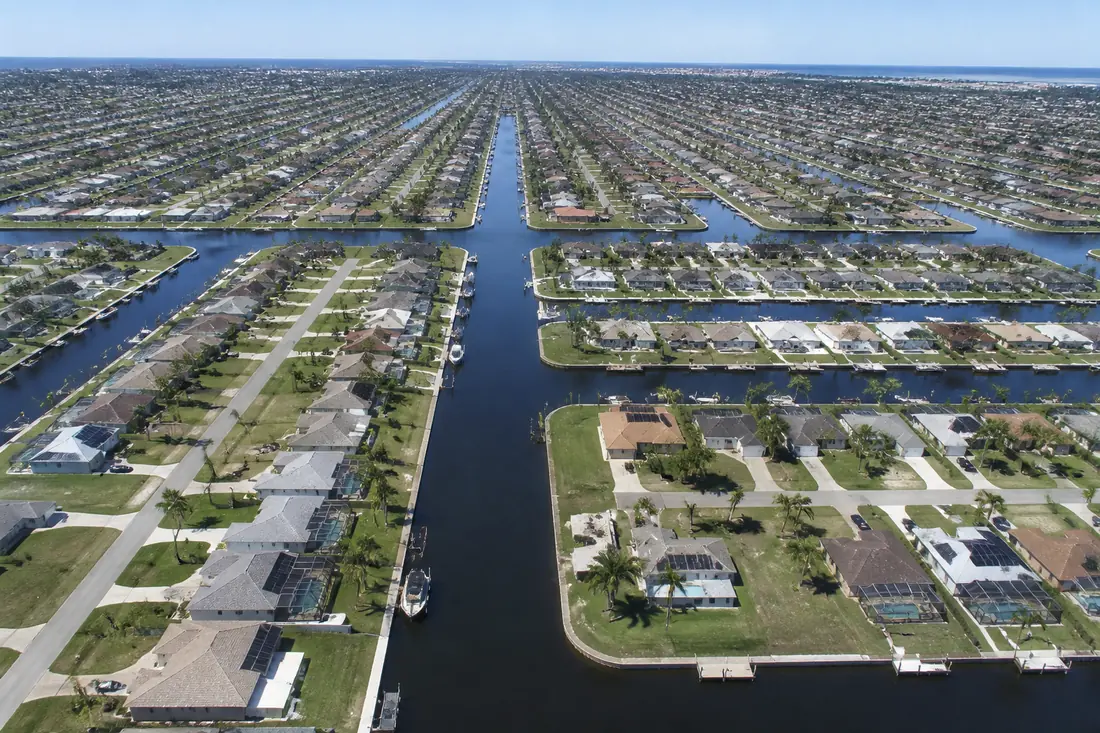
It is easy to read the water at the end of the yard as a feature dug for the view. The City describes it as something more deliberate:
The Cape Coral canal system is intentionally designed to provide flood control, water quality benefits, and the freshwater canals also provide for irrigation storage.
Canals move stormwater away from homes and streets to reduce flood risk in heavy rain. In the freshwater system, weirs and control structures manage levels and hold excess stormwater back. The saltwater canals do a different job: they connect to open water, they are tidal, and the water in them is corrosive in a way fresh water is not.
Which system a property sits on changes what the wall deals with daily. A tidal saltwater canal works a wall through a cycle twice a day and puts chloride against the concrete and the steel inside it. A weir-controlled freshwater canal holds a far steadier level. The City publishes a map of which canals are which.
Why the failure starts on the dry side
A seawall is a retaining structure, and it works as a system: the panels, the cap tying them together, the tiebacks anchoring it back into the yard, and the drainage that lets water out of the retained soil instead of letting it push. Every one of those is on the land side or inside the structure. None is visible from a boat.
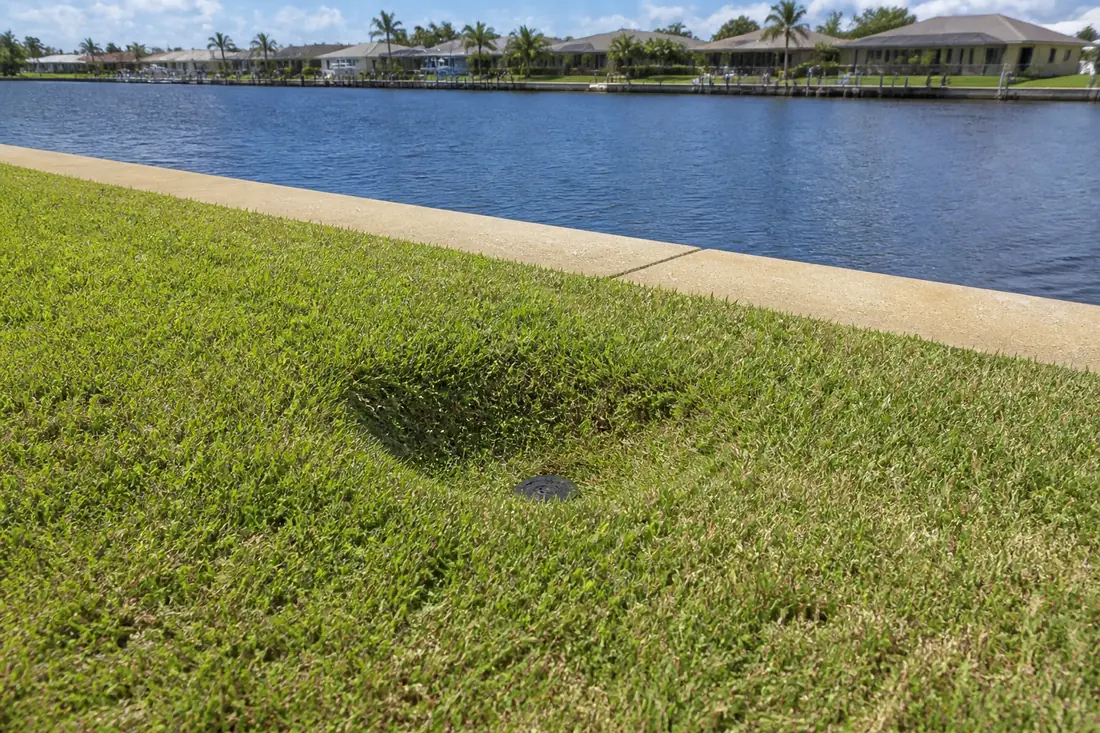
Water moves through the soil behind the wall — rain, irrigation, tidal exchange through the joints. If it finds a path out that also carries fine material, it takes some of the yard with it each time. That soil ends up in the canal; sedimentation is one of the stated reasons the City’s dredging program exists.
What is left behind is a void, working its way up. The surface holds for a long time because compacted fill and turf bridge a surprising amount of empty space. Then a sprinkler head drops, or after heavy rain a depression appears overnight where the ground finally gave.
The wall has not moved. But the material it was built to retain is going, which is why void filling and soil stabilization is its own category of work rather than part of a repair. Caught early, it is often the whole job.
What the warning signs actually mean
Owners tend to look for cracks. Read in the right order, the signs tell you roughly how far along the process is.
Depressions or settling near the wall line. The earliest signal, and the most often dismissed. Material has already moved.
Slabs, pavers or pool decking tilting toward the water. The same mechanism, now under something rigid enough to show it.
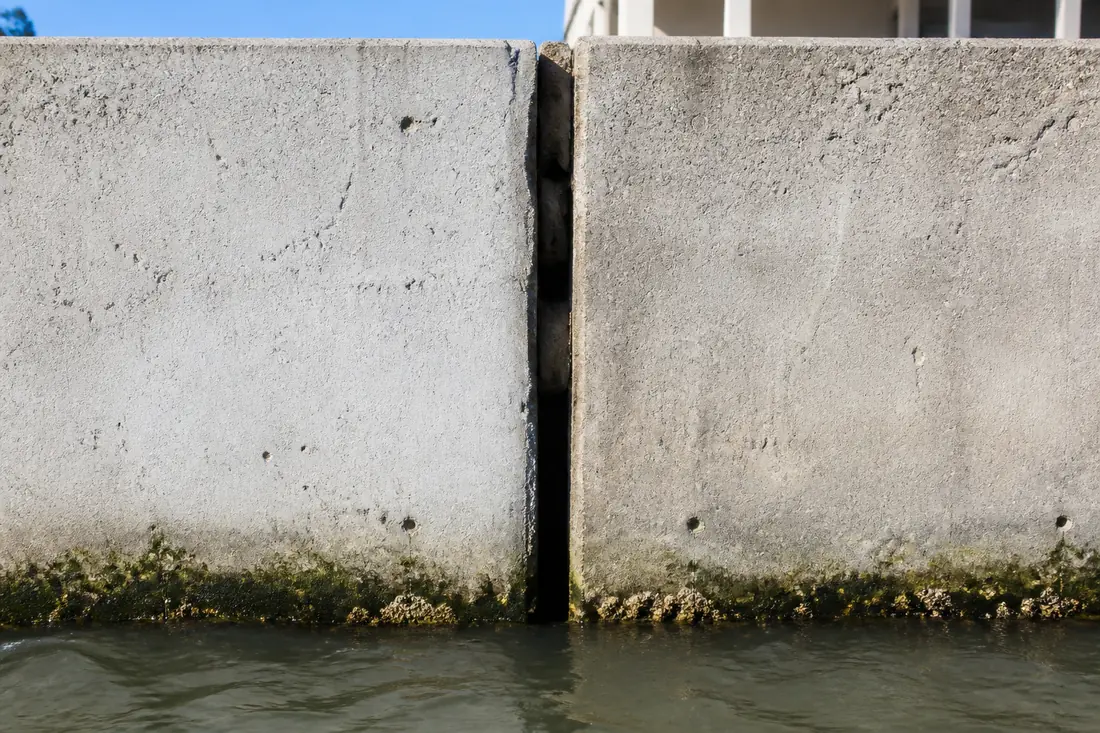
Separation at the vertical joints between panels. This is the route out. It is also where intervention costs least, which is the argument for looking closely rather than glancing along the wall from the dock.
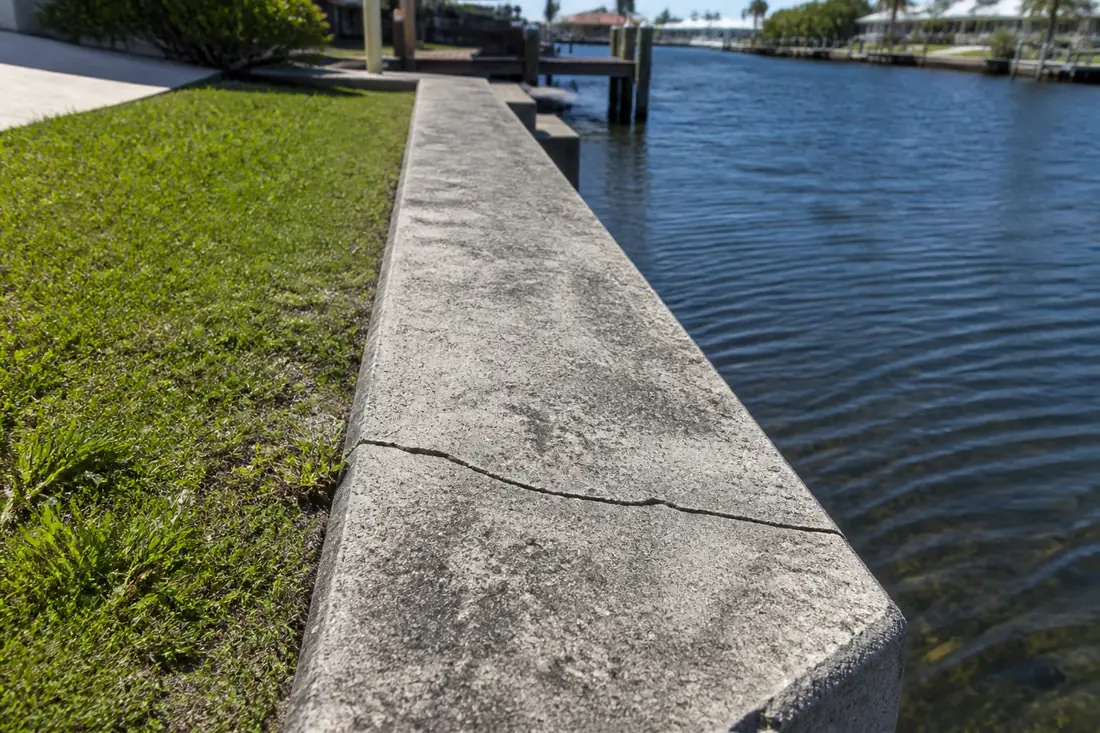
Cracks in the cap that open over time, or run through it rather than along it. Different from a shrinkage line that has looked the same for a decade.
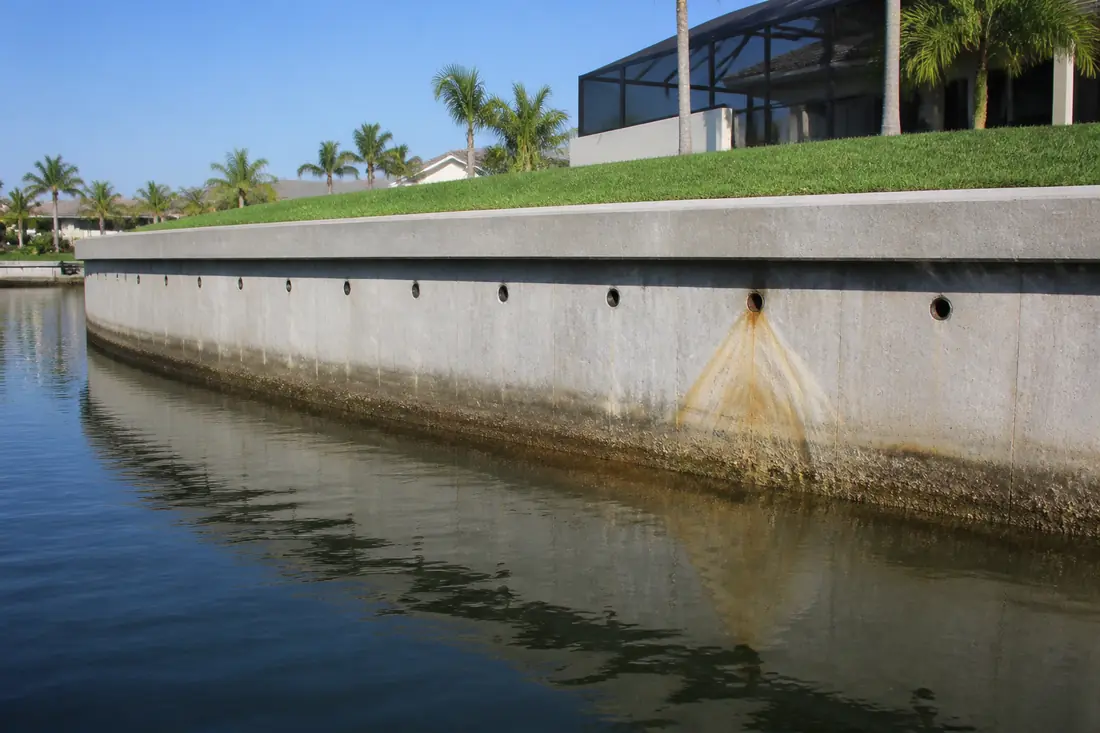
Weep holes that never run — or that run soil rather than water. Weep holes are a designed pressure release. One that has stopped discharging suggests its filter has blinded and pressure is building. One discharging a fan of pale material is the signal to act on quickly: it is unambiguous, visible from the dock, and it means the loss is happening now.
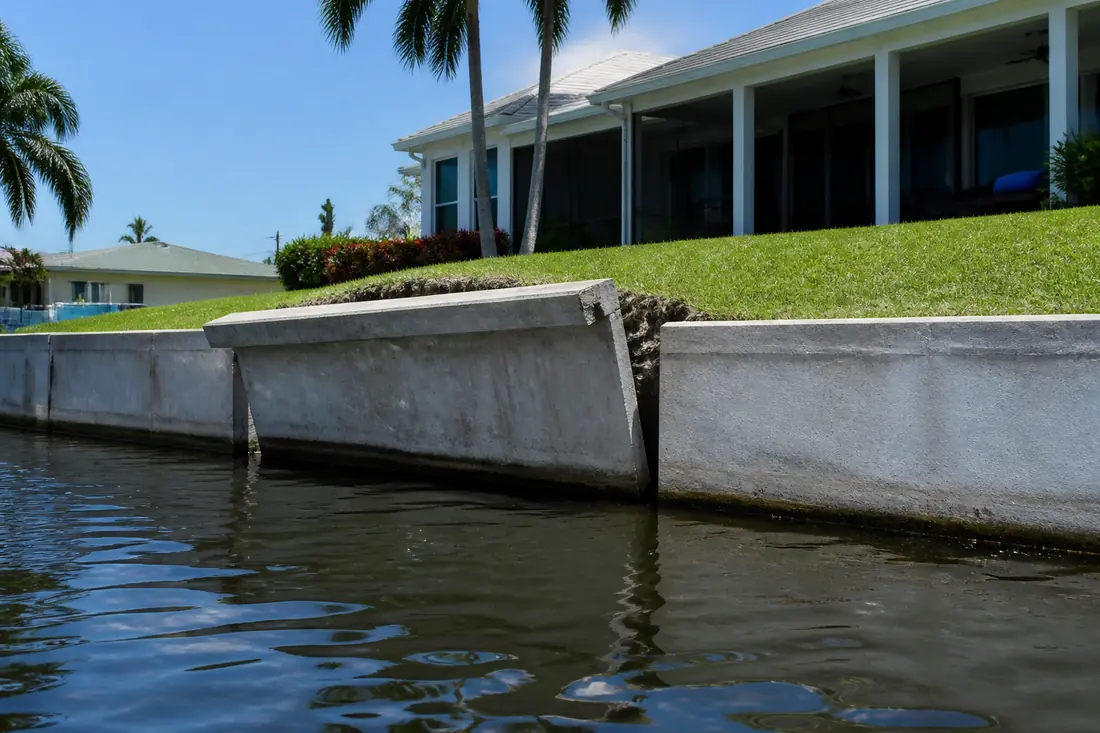
A wall that has begun to lean, bow or rotate at the top. By this point the discussion is usually tieback repair or replacement rather than sealing anything.
What Ian actually did to this canal system
A seawall article for Cape Coral that never says what happened here in September 2022 is leaving out the most relevant local fact there is.
Hurricane Ian came ashore on Cayo Costa on 28 September 2022 at 130 kt — around 150 mph — and the National Hurricane Center recorded maximum inundation of 6 to 9 feet above ground level in Pine Island, Cape Coral and the other communities along the mouth of the Caloosahatchee River. Two of the USGS water level sensors, one in Matlacha and one in Cape Coral, were lost or destroyed before they finished the job. At Punta Rassa, at the east end of the Sanibel Causeway, a sensor recorded a wave-filtered level of 8.37 ft above mean higher high water. Up the river at the downtown Fort Myers tide gauge the figure was 7.26 ft above MHHW, and the surge there was strong enough to reverse the direction of the river’s flow.
Those figures sit inside a steep gradient. On Fort Myers Beach and Estero Island the same storm produced 10 to 15 ft above ground level, and the highest measurement anywhere in the USGS network was 12.70 ft above MHHW at the Fort Myers Beach pier. Cape Coral is on the sheltered side of that gradient, several feet down from the barrier islands, which is why the two places tell such different stories about the same afternoon.
Further north the storm behaved differently again: sensors in Port Charlotte and Englewood stayed dry, because the winds on that side of the track pushed water out rather than in. Thirty miles apart, opposite events.
The scale in this county was still severe. In Lee County at least 52,514 structures were impacted, of which 5,369 were destroyed and 14,245 sustained major damage, and 36 of the 41 storm surge deaths in the United States occurred here.
That difference is worth holding onto, because it explains why advice that circulates after a storm often does not transfer between towns on this coast. Here, water came in.
What that does to a wall is a reversal of everything it was built for. A canal seawall spends its life holding soil back and water in front, with the pressure acting from the yard toward the water. Surge equalizes and then exceeds the water side, and when it withdraws it leaves the backfill saturated while the support in front of it drops away. The load runs backwards, then forwards again, on a wall whose tiebacks were sized for one direction.
A wall that was sound came through that. A wall that already had open joints, a cracked cap or soil leaving through its weep holes was being asked to do something it had no margin left for — and the failure often did not present until months later, which is the pattern owners here describe and the reason a wall that “got through Ian fine” is not a wall with a clean bill of health.
What someone doing this for a living looks at
An inspection works through the system in the order the system fails.
The wall is sighted along its length from both ends, because seawalls go out of line gradually and nobody’s memory of straight is reliable. An owner who takes the same three photographs each spring is genuinely ahead.
Then the joints, closely, for separation, displacement and visible soil. Then the cap, for whether the crack pattern suggests movement or shrinkage. Then the weep holes, for whether they discharge and what. Then the toe, where the wall meets the canal bottom, because what sits in front of the base is part of what supports it.
Behind the wall, the yard is walked for soft ground and depressions, and the hard surfaces checked for tilt and for gaps opening at their edges. Where voids are suspected, probing establishes how far they extend — the visible dip is usually smaller than the hollow underneath.
Tiebacks and deadmen are buried, so nobody sees them during a normal seawall inspection. Their condition is inferred from how the wall behaves. That inference is most of the skill.
Repair or replacement?
There is no general answer, and anyone offering one without looking at the wall is guessing.
Repair tends to make sense when the wall is still in line, the cap is sound or locally repairable, the problems are confined to joints and drainage, and the loss behind the wall is measurable and fillable. A wall like that has failed at the pathways rather than as a structure.
Replacement moves into the frame when the wall has rotated or bowed along a run rather than at one panel, when the anchoring is no longer doing its job, when the base has been undermined, or when the reinforcement inside the concrete has begun to corrode and expand — which pushes the concrete apart from the inside and is not something a surface repair reaches.
The awkward middle is a wall that is sound in most respects but has one bad run. Repairing sound work to a structure that is still moving is how money gets spent twice.
Age alone is a poor guide. Two walls built the same year on the same canal can differ entirely depending on how they were drained, whether the backfill was suitable, and whether anyone dealt with a joint that opened a decade ago.
What drives the cost
There is no meaningful single price without knowing the length involved, what is behind the wall, what is in front of it and what access looks like. The variables that move it most:
- Length, and whether the whole run needs the same treatment. Two panels and 100 feet are different orders of work.
- What is behind the wall. The volume of void to fill, and whether it sits under open lawn or under a pool deck.
- Access. Whether equipment can reach the wall from the land side, or whether the work comes from the water.
- What is attached. Docks, lifts and steps may have to be worked around or reinstated.
- Permitting. Which authorities are involved depends on the waterway and on what is being changed, and a permit condition can change the design before a scope is priced.
Four mistakes that make this more expensive
Treating a lawn depression as a landscaping problem. Topsoil restores the lawn and hides the signal. The void underneath is still growing.
Waiting for the wall to look wrong. By the time it visibly leans, the cheap interventions have been passed.
Judging a wall by the neighbor’s. Adjacent properties on the same canal can be in completely different condition.
Sealing a joint without addressing what went through it. Closing the pathway does not put back the material that already left — leaving the same support problem and one less symptom to read.
Buying on a canal? Check the wall before you close
The canal is maintained by the City. The wall is not, and the difference matters most while it is still someone else’s problem to price. Worth establishing before closing:
- whether the wall is in line, sighted from both ends
- whether any joints have opened, and whether soil is visible in them
- whether the weep holes discharge, and what they discharge
- whether the lawn and hard surfaces near the wall show settlement
- whether the canal is a freshwater or saltwater reach
- what has been attached to the wall over the years, and by whom
A wall with early joint separation and a couple of voids is a plannable expense that can be negotiated. The same wall three years and a few storm seasons later is a replacement.
Where to start
If the yard is showing signs and the wall is not, that is the good version of this problem.
Look at the wall properly, from both sides, and photograph it from fixed positions so next year’s look means something. Treat weep holes discharging soil as urgent. Deal with open joints early. And where the ground has already moved, find out how far the void extends before deciding what the repair is.
Regulation of seawalls in Cape Coral has changed over time, and this article does not state the current permitting position. Confirm that with the City for the specific property before planning work.
If the yard behind your wall has started to move, a seawall inspection is the step that tells you whether this is a repair, a filling job, or a wall that has reached the end of its service.
Sources
Checked 3 September 2026.
- National Hurricane Center, Tropical Cyclone Report: Hurricane Ian (AL092022) — source of the 6 to 9 ft above ground level inundation in Cape Coral and Pine Island, the loss of the Matlacha and Cape Coral water level sensors, the 8.37 ft above MHHW at Punta Rassa, the 7.26 ft above MHHW at the downtown Fort Myers gauge and the reversal of the river’s flow, the 130 kt Cayo Costa landfall intensity, the 10 to 15 ft inundation and 12.70 ft above MHHW peak at Fort Myers Beach, and the Lee County damage figures of 52,514 structures impacted, 5,369 destroyed and 14,245 with major damage alongside 36 of the 41 US storm surge fatalities, and the finding that the Port Charlotte and Englewood sensors stayed dry because of offshore winds
- City of Cape Coral — Canal Dredging Program — source of the 400+ mile figure, the quoted description of the canal system’s purposes, the role of weirs in the freshwater canals, and sedimentation as a reason for dredging
- City of Cape Coral — Stormwater
- City of Cape Coral — Fresh Water and Salt Water Canals map